

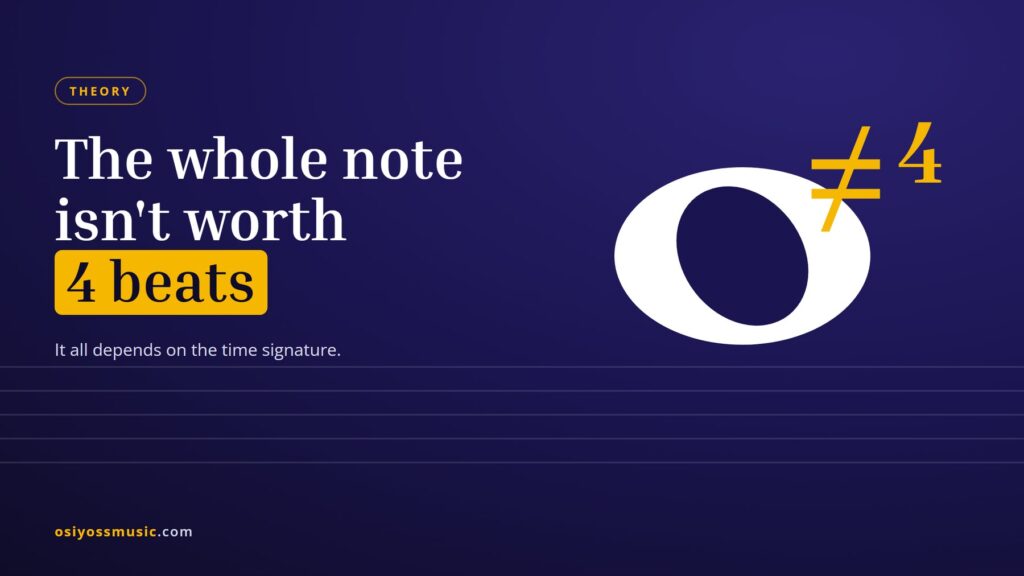
If you don’t agree with the title, this article will probably make you a little anxious, but don’t worry: we’ll help you take it in, and by the time you finish reading you’ll have learned something new. The idea you probably have about whole notes works like training wheels on a bike: they keep you from falling while you learn, until you get better and take the training wheels off. That transition will sometimes make you fall, but eventually you make it and become a true expert, able to teach others.
Training wheels
Let’s start at the beginning, when the whole note is worth 4 beats. Yes, you read that right, but maybe you’ve already caught a key detail… It isn’t always worth the same. It all depends on the time signature, that fraction-like number at the beginning of a score.
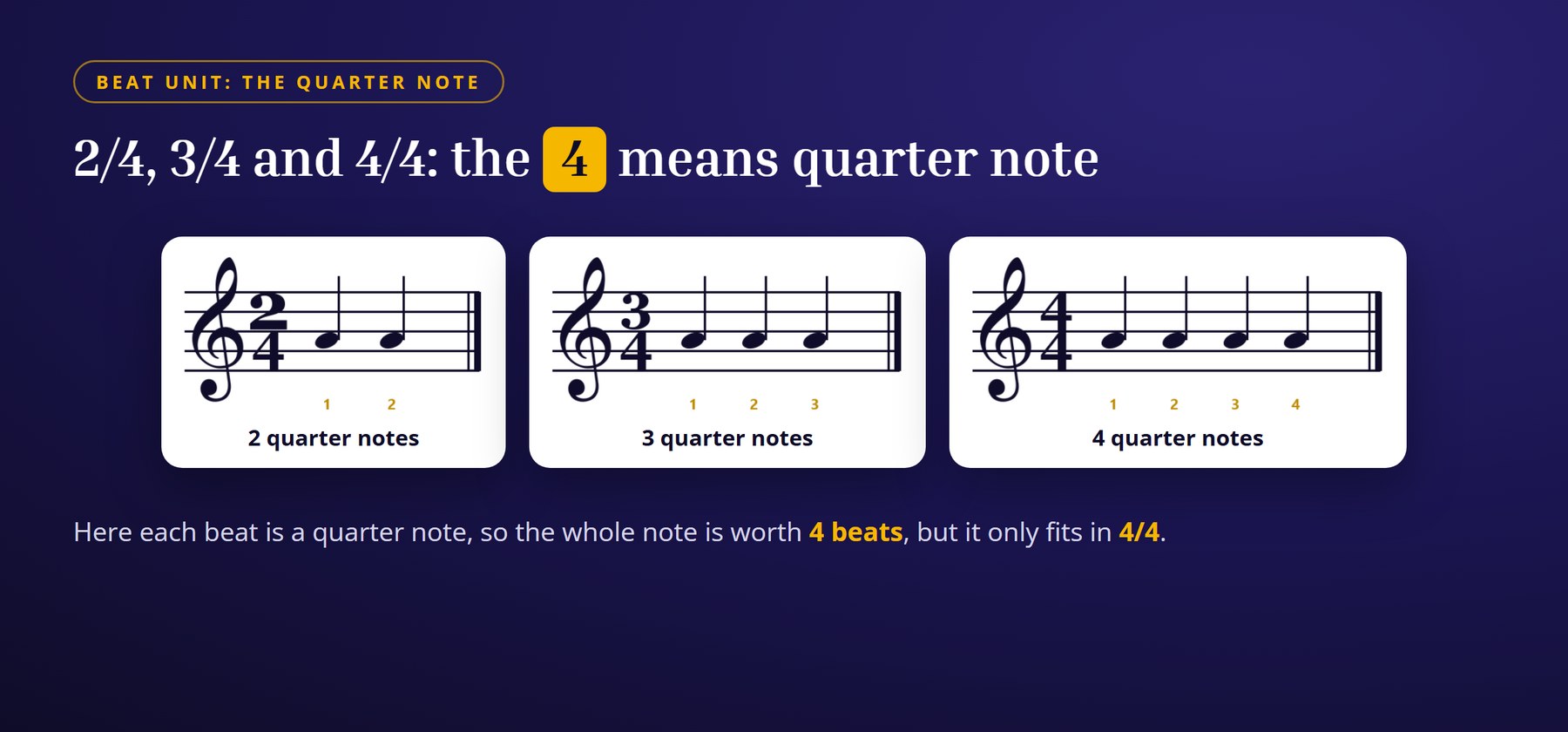
In these three time signatures the whole note is worth 4 beats, but it can only be used in the last one (4/4), because the first two only have 2 and 3 beats respectively (not enough room for a whole note). Now, when the time signature changes, the value of the whole note changes too, but its relationship with the other note values never changes. We’ll talk about that later, but first let’s see when it is not worth 4 beats.
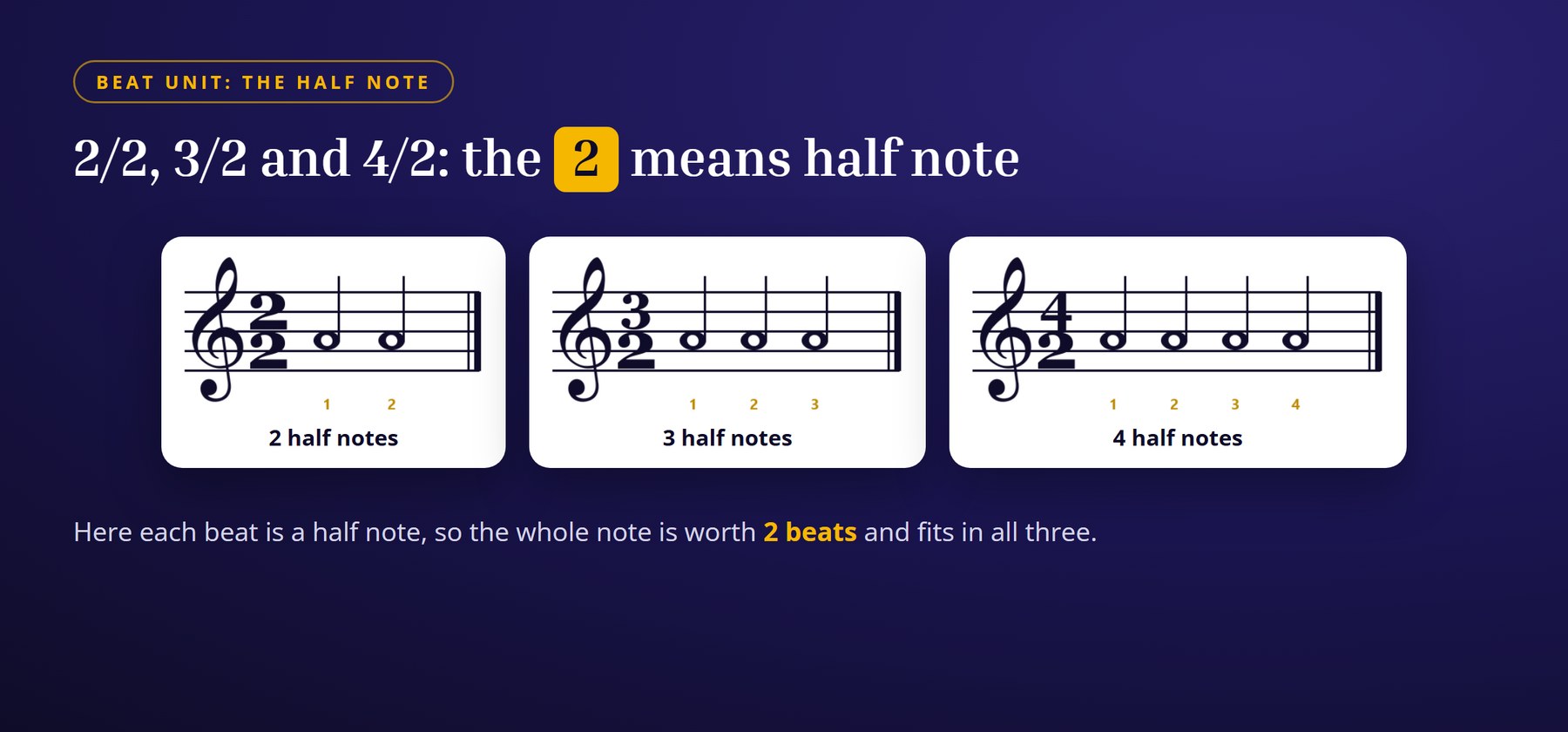
In these three time signatures the whole note is worth 2 beats, and it can be used in all of them. Now it’s true: the whole note isn’t worth 4 beats. Let’s see why.
Beat unit
It’s the note value that, as set by the time signature, equals one beat. In other words, if we turned on a metronome and decided that each click is one beat, it’s the time signature that sets which note value will take up each beat. The way to identify it depends on whether the time signature is simple or compound, but so we don’t stray from the point of this article, we’ll leave that topic for another post.
However, you should know that all the time signatures shown in this article are simple, and their beat unit is set by the bottom number, which stands for the note value that takes up one beat. To understand why the number 2 stands for the half note and 4 for the quarter note, keep reading.
Time signature
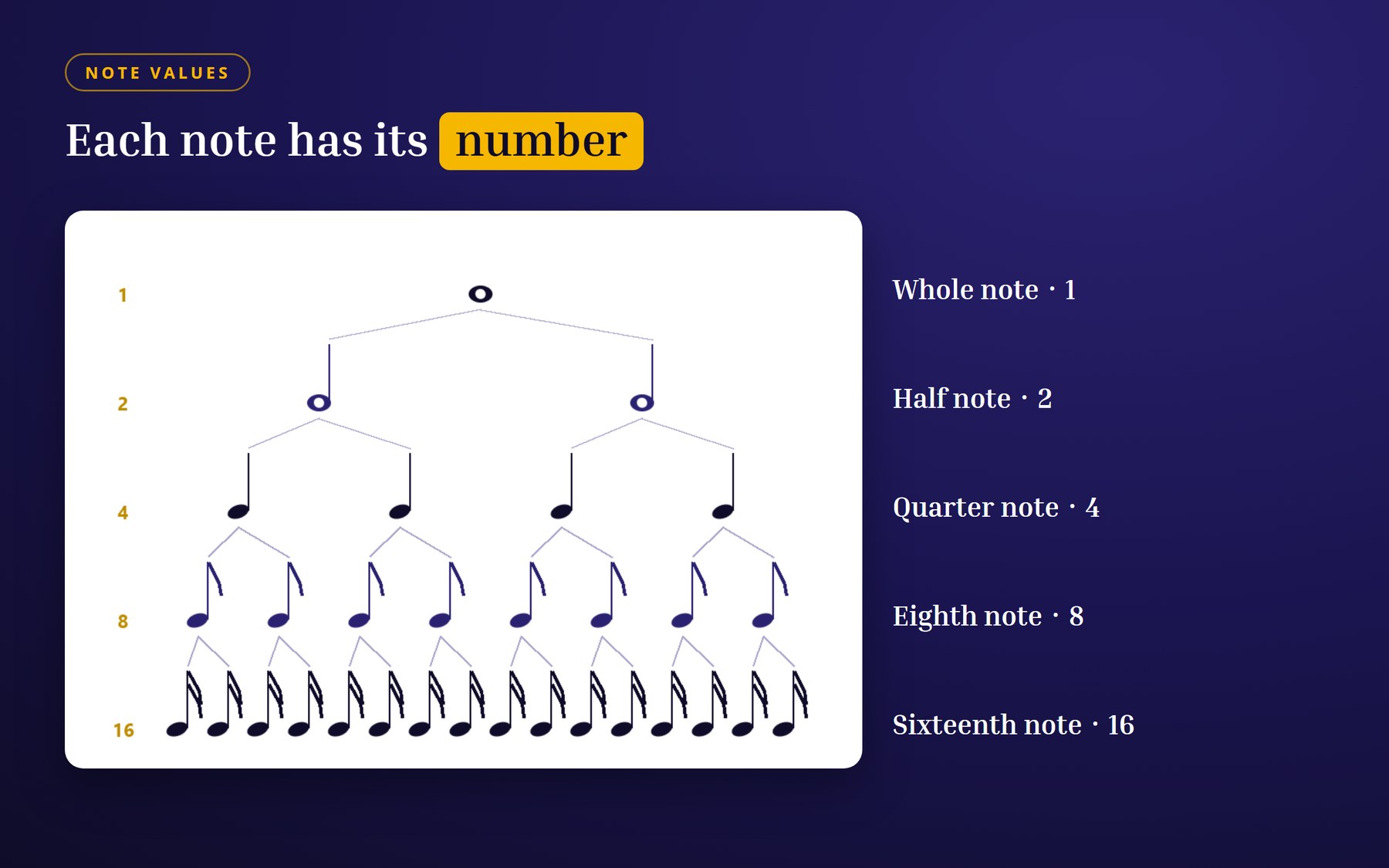
Every time signature has, just like a fraction, a top number and a bottom number. The top one tells you how many note values fit in a bar, and the bottom one tells you which note value the top number is talking about. The whole note is the value that stands for the unit (1), and from there you multiply by 2 to get the number for each next smaller value: the next one on the list is the half note, 1 × 2 = 2, so the half note is 2; then the quarter note, 2 × 2 = 4, and so on.
This is something we should memorize rather than calculate, so that as soon as we see the number we know which note value it stands for. But while you’re starting out, what we just explained is your training wheels.
What never changes
Now that we’ve come this far: at the beginning, with the training wheels, we left something for later. You’ve arrived, so let us tell you about something that is fixed and never changes: the relationship between note values. As you can see in the previous image, a whole note equals two half notes, a half note equals two quarter notes, and so on. This never varies, and it doesn’t depend on any outside factor, such as the time signature.
So if I asked you how many beats a whole note is worth, what would you say?… If you thought “it depends on the time signature”, you’re right. And if I change the question a little: how much is a whole note worth? Notice I didn’t say the word beat… Answer: a whole note equals two half notes, or four quarter notes, or two quarter notes and a half note, and so on. Never let that question catch you off guard again: now you know what to say.
Listen to it
To wrap up, here’s an example: 2 scores with whole notes and the metronome marking the beats. In the first one the whole note is worth 4 beats, so while the whole note sounds you hear 4 metronome clicks; in the second one the whole note is worth 2 beats, so while it sounds you hear only 2 clicks. Enjoy!


0 Comments